✉ hello@onemoregarden.com


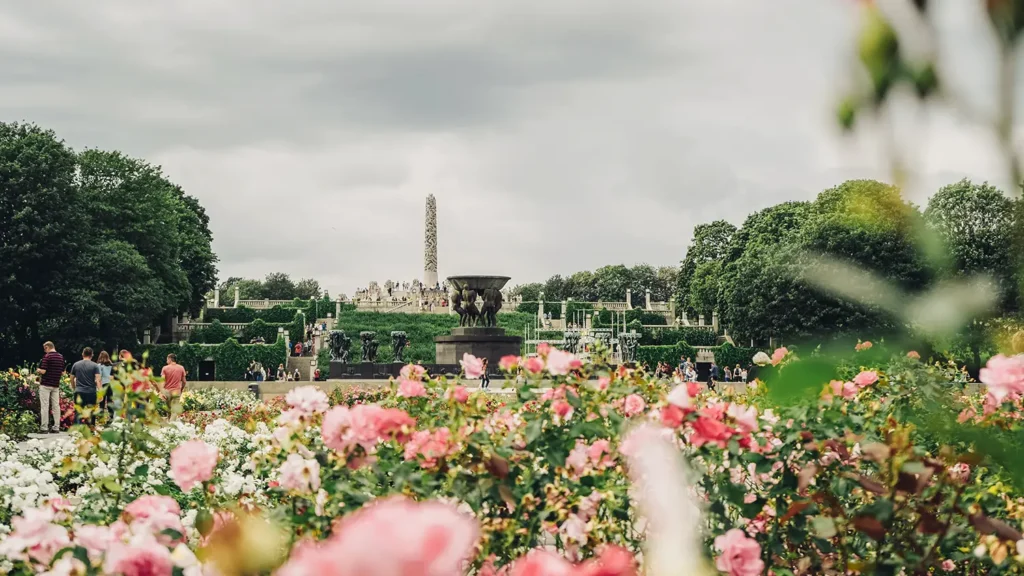
I have to admit, I’m usually not the biggest fan of sculpture parks. But when I visited the Vigeland Sculpture Park in Oslo for the first time, I was absolutely stunned. Can you believe that this entire park is the work of just one artist? What really struck me was how the statues depict such mundane scenes, making them incredibly relatable. If you’re planning to visit Oslo, take it from me: you absolutely have to visit this park.
What is the Vigeland Sculpture Park?
Nestled in the heart of Oslo, Vigeland Park (or Vigelandsparken in Norwegian) is the largest green space in the city. Open at all times, it’s a very popular spot, attracting one to two million visitors every year.
Let me clear up any confusion right away: Vigeland Park and Frogner Park refer to the same place, but the official name is Frogner Park. The ‘tourist name’ Vigeland Park leaves no doubt about who made the park so famous: Gustav Vigeland. This Norwegian sculptor is the mastermind behind the more than 200 sculptures that the park is known for.
In fact Vigeland Park is the biggest sculpture park in the world created by just one artist!
A brief history: from Frogner Manor to Vigeland Sculpture Park
In the 18th century, the area that now includes Vigeland Park was the private property of general Hans Jacob Scheel. He designed the landscape in a Baroque style, but when business magnate Benjamin Wegner took over the estate in the 19th century, he transformed it into a Romantic park. After Norway gained independence in 1905, the city of Oslo purchased large parts of the estate to make room for the city’s expansion. The remaining part was to become a public park. But what about the design of this park? Enter Gustav Vigeland.

The story of how Gustav Vigeland came to develop Frogner Park is quite fascinating. In 1921, the city of Oslo decided to demolish the artist’s studio in Hammersborg. However, Vigeland was considered Norway’s best sculptor at the time, which gave him some serious bargaining power. He struck an interesting deal with the city: he’d get a new studio in Frogner, built specifically for his needs in a prime location. In return, he’d donate all his future works to the city.
And so it happened. This deal laid the foundation for the creation of the park, its name forever linked to the artist. And that studio in Frogner where the Gustav Vigeland lived and worked? It’s now the Vigeland Museum, which I highly recommend visiting if you have the chance.
The construction of the Vigeland Park
The construction of the sculpture park began in 1924, and Gustav Vigeland continued working on the park’s development for nearly twenty more years – until his death in 1943. Surprisingly, the entire park is not the result of a previously thought-out plan, but evolved gradually over time. An army of skilled craftsmen brought Vigeland’s designs to life in granite, bronze, and in the wrought-iron gates and fences.
But it wasn’t just the sculptures that were designed by Gustav Vigeland; he also conceived the layout of the park, the architectural elements, and even the landscaping.
Virtual tour of Vigeland Park
Of course, nothing beats visiting the park and seeing everything with your own eyes. With the guide below, you can prepare for your visit and decide on your personal ‘must-sees’.

The main entrance
As you approach the park on Kirkeveien, you’re greeted by five large gates and two smaller pedestrian gates. Designed in 1926, the wrought iron gates are adorned with various botanical motifs, dragons, and other mythical creatures. I was particularly intrigued by the dragons,which are recurring elements in Vigeland’s work and possibly symbolize the dangers and evil forces in life.
To the right of the main entrance, you’ll spot a statue of Vigeland himself. Yes, he sculpted his own statue!
The Bridge
From the main entrance, two parallel paths lead you to the bridge, which is part of the central axis running through the park. The bridge is a highlight, featuring 58 bronze sculptures created between 1926 and 1933, and on each corner stands a granite statue depicting people struggling against enormous dragons.
Overview of the 58 sculptures on the bridge in Vigeland Park
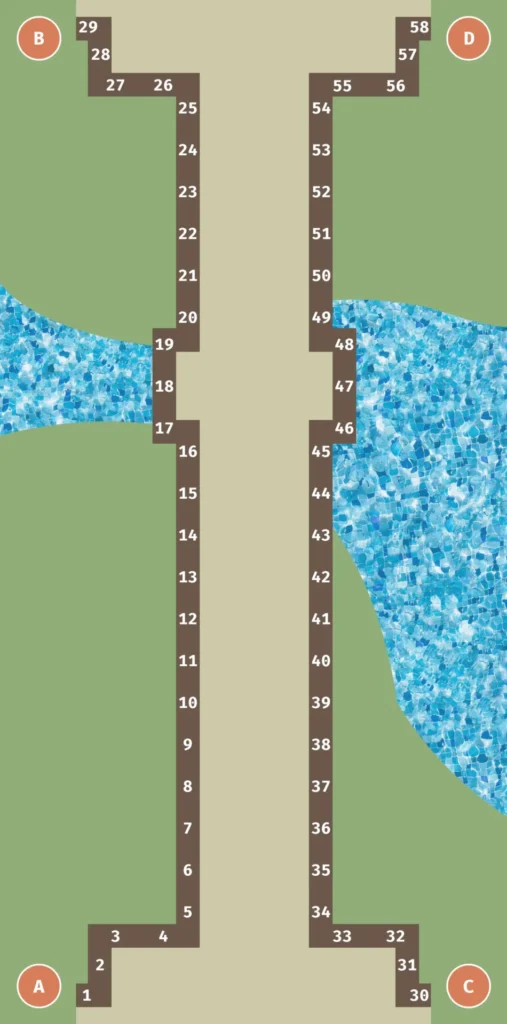
| Statues on the left side, starting from the park entrance: | Statues on the right side, starting from the park entrance: |
|---|---|
| 1 • Girl with infant on her head | 30 • Boy with infant on his head |
| 2 • Woman with infant in her arms | 31 • Man carrying two infants |
| 3 • Woman lifting infant in front of her | 32 • Man swinging infant |
| 4 • Small girl standing behind woman | 33 • Woman with infant on her arm |
| 5 • Two boys looking up | 34 • Two girls behind each other |
| 6 • Woman carrying sleeping child | 35 • Man running with boy on his back |
| 7 • Girl standing in front of woman | 36 • Girl facing woman |
| 8 • Young woman with her hands at her side | 37 • Girl with her hands on her head |
| 9 • Boys running | 38 • Man lifting girl |
| 10 • Man with his hands at his side | 39 • Young man with his hands at his back |
| 11 • Man with his hands by his side | 40 • Man with his arms crossed |
| 12 • Man and woman dancing | 41 • Old man beating young boy |
| 13 • Woman with her hands at her back | 42 • Woman with her hands over her mouth |
| 14 • Woman with her hands by her side | 43 • Elderly and young man |
| 15 • Man hitting woman over the head | 44 • Man lifting woman in front of him |
| 16 • Man and woman facing each other | 45 • Woman standing behind man |
| 17 • Small boy crying (The Hothead) | 46 • Small girl smiling |
| 18 • Man inside a ring | 47 • Man and woman inside a ring |
| 19 • Small girl with her arms extended | 48 • Small boy looking sideways |
| 20 • Man standing behind woman | 49 • Man standing behind woman |
| 21 • Man running | 50 • Man carrying woman ahead of him |
| 22 • Woman with her arms above her head | 51 • Young woman with her hands clasped |
| 23 • Woman smiling | 52 • Young woman with head on one side |
| 24 • Woman jumping over man | 53 • Young woman dancing |
| 25 • Man with infant in his arms | 54 • Man with his hands behind his neck |
| 26 •Boy standing in front of man | 55 • Man with boy on his shoulders |
| 27 • Man lifting older man | 56 • Man juggling four infants |
| 28 • Old man with boy on his back | 57 • Old man leading small boy |
| 29 • Man looking sideways | 58 • Man with his hands on his chest |
| The granite corner sculptures on the left side: | The granite corner sculptures on the rightside: |
| A • Man fighting small serpent, c. 1930 | C • Womenfolk being embraced by serpent, 1918 |
| B • Man fighting serpent, 1918 | D • Serpent crushing naked man, 1930 |
The Fountain

After crossing the bridge and walking through the rose garden you enter the Fountain. Not the water itself, of course, but a big square with the bronze fountain in the center. This is actually the oldest part of the park. I always find it funny how so many great artists throughout history have reserved a place for themselves in their artworks. The same goes for the fountain’s water basin, which is supported by six giants – one of them Gustav Vigeland himself.
Around the fountain there are twenty sculptures of people and trees – five in each corner – depicting life from birth to death. The final statue shows a skeleton in a tree, as a symbol of the cycle of life. As a gardener all I could think was how everything that dies becomes food for other lifeforms – for worms, insects and plants …
The Monolith

Crossing one more green area, you rise up to another masterpiece: the monolith. As you climb the stairs to reach this 17-meter high column of intertwined human figures, you’re treated to spectacular views of the surroundings. The 36 granite statues along the stairs, created between 1915 and 1936, continue the theme of people in everyday situations. Some of the statues really hit the feels, such as the man carrying a dead body, or the kids horse-riding on the back of a woman.

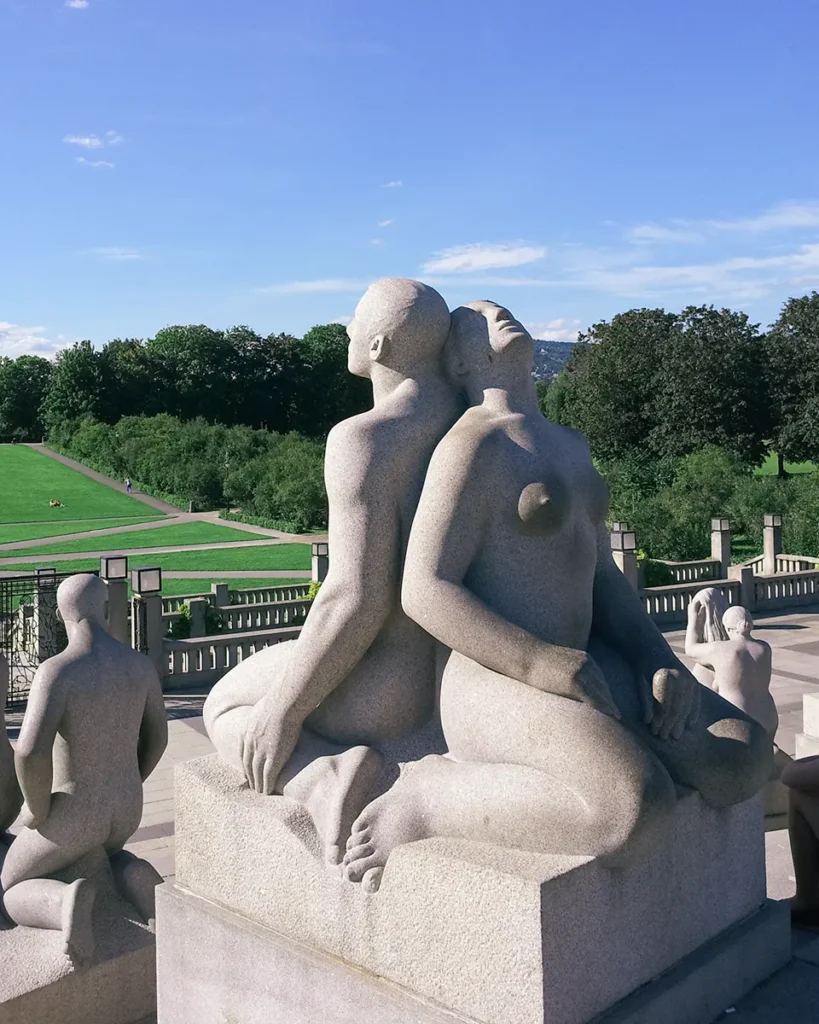
Flora in Frogner Park
While the sculptures are undoubtedly the stars of the park, don’t overlook the natural beauty. With some 3,000 trees, including both native and exotic species (some over 250 years old!), and a rose garden boasting nearly 15,000 roses, it’s a feast for the eyes. I was impressed to learn that all of this is maintained in an eco-friendly way.
The Vigeland Museum
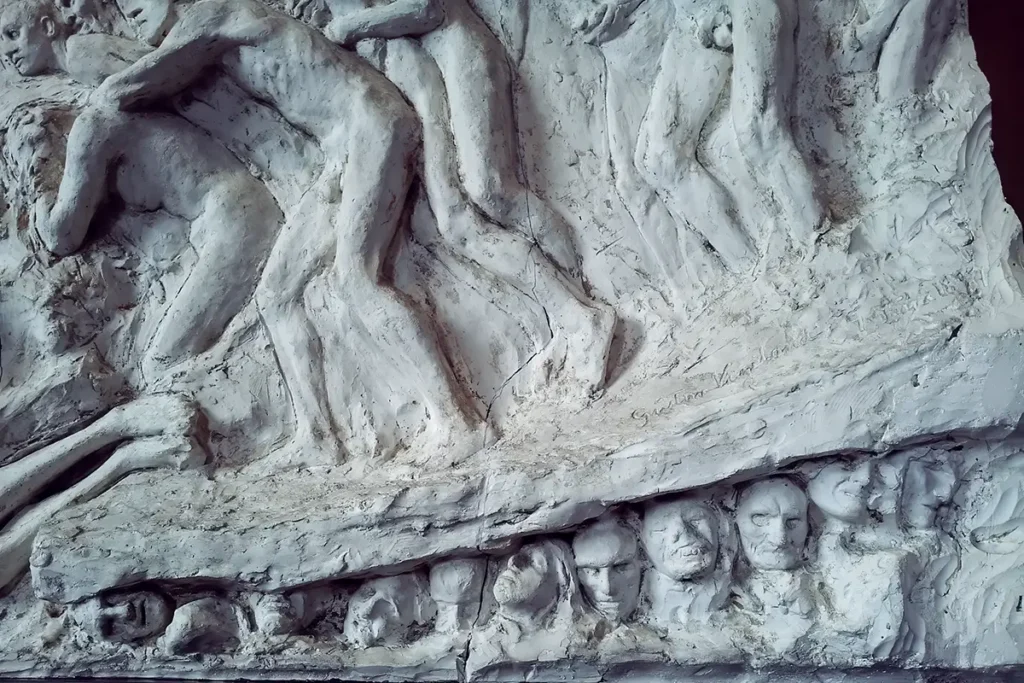
If you’re as fascinated by Vigeland’s work as I was, don’t miss the Vigeland Museum. It’s just a five-minute walk from the main entrance. This is where Gustav Vigeland worked and lived until his death. I found it really interesting to see the development of his entire career, including sketches and designs not only for Frogner Park but also for his other projects throughout Norway. Really fascinating are the models of the sculptures in the park – part of them true to their final size.
/gal


Emanuel Vigeland: the often overlooked brother
Here’s a little insider tip for you: while Gustav Vigeland is celebrated as one of Norway’s greatest artists, his younger brother Emanuel was – in my opinion – equally talented. If you’re in Oslo on a Sunday, make sure to visit Emanuel’s mausoleum, the Tomba Emanuelle. It’s only open one day a week (as it’s run by volunteers), but trust me, it’s worth planning your visit around it.
Entering the mausoleum is an experience in itself. You have to bow your head to get through the low door, symbolically bowing to the artist whose ashes are placed in an urn above the entrance. Once inside, give your eyes a moment to adjust to the darkness. What you’ll see is absolutely breathtaking – one massive fresco covering every surface from floor to ceilng, depicting the cycle of life – sometimes in explicit detail – from conception and birth to death and decay.
But it’s not just the visuals that are overwhelming. The acoustics in the mausoleum are incredible. Every sound, even the tiniest whisper, bounces off the walls and lingers in the air. It’s an eerie and unforgettable experience. My advice? Keep quiet and feast your eyes!
Visitor’s guide to Vigeland Park
Address: Kirkeveien (main entrance), Monolitveien (back entrance)
Official website Vigeland Park
Opening hours and prices
- The Vigeland Sculpture Park entrance fee is … none! The park is always open and free, so don’t hesitate to visit.
- The Vigeland Museum costs about 120 NOK (adults, with reduced prices for seniors and young adults. Kids up to the age of 17 can enter for free. The museum is closed on Mondays. Check the museum website for exact prices and opening times.
- Tomba Emanuelle (Emanuel Vigeland Museum) is only open on Sundays, from 11:30 to 16:00. Booking your tickets and a time slot in advance via the museum’s website is strongly recommended. Tickets for adults are 100 NOK, kids can enter for free.
How to get to Vigeland Park (and Tomba Emanuelle)
Getting to the Frogner Park by public transport is easy. There are bus and tram stops right in front of the main entrance on Kirkeveien. Just take tram 12 or bus 20 to Vigeland Park. If you don’t mind a bit of (extra) walking, you can take the T-Bane (subway) to Majorstuen. From this station it’s about a 15 minute walk to the park entrance.
To get to the Tomba Emanuelle (in the planner you can enter Emanuel Vigeland Museum), it’s easiest to take subway line 1 to the stop Slemdal. From there it’s just a short walk to the mausoleum.
To plan your journeys in the city of Oslo, just use the planner (for all types of public transport) at Ruter.
Getting to Vigeland Park by car
If you want to go by car, you can use municipal street parking (or Gateparkering in Norwegian) or commercial car parks. Please remember that prices vary, depending on when and where in the city you are parking. The nearest Vigeland Park parking spot to the main entrance is probably around Nordraaks gate. Check this great map of street parking spots in Oslo. There are of course also commercial car parks, such as the Colosseum P-hus Q-Park, in Essendrops gate.
Is it worth visiting Vigeland Park?
If you’re planning a trip to Oslo, I can’t recommend the Vigeland Sculpture Park enough. It’s a unique and thought-provoking experience that will stay with you long after you’ve left. And if you can, try to squeeze in a visit to Emanuel’s mausoleum too – it’s a must-experience well worth your time.
Description for this block. Use this space for describing your block. Any text will do. Description for this block. You can use this space for describing your block.