✉ hello@onemoregarden.com


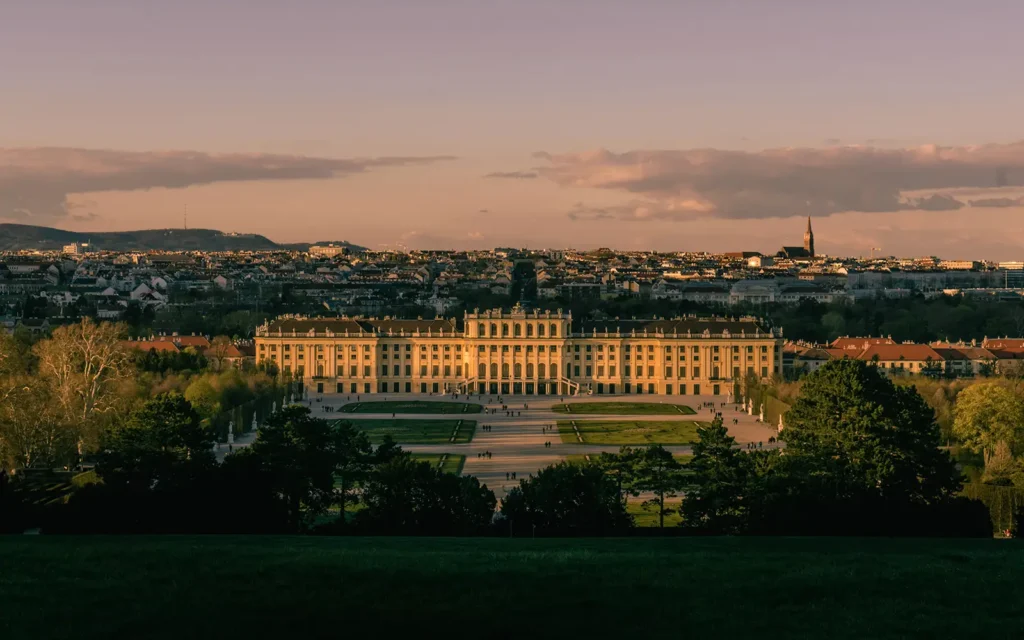
Schloss Schönbrunn in Vienna is so much more than just a pretty palace. The total combination of the palace and the grounds are a work of art! There’s a reason Schönbrunn Palace in Vienna is a UNESCO World Heritage site. Now of course, I have a special interest in the gardens, which we are going to dive into shortly. But to better understand the palace gardens (the Schönbrunn Park), you’ll need a bit of historical background.
About the name ‘Schloss Schönbrunn’
First, a bit about the name. If you came to this website searching for ‘Schoenbrunn Palace’ or ‘Schloss Schoenbrunn’, you might be wondering why we’re talking about ‘Schönbrunn Palace’ and ‘Schloss Schönbrunn’. Well, that’s because the German ‘ö’ (o umlaut) can be written as ‘oe’ if you can’t find the ö on your keyboard … The word ‘schönbrunn’ is actually a combination of the words ‘schön’ – meaning beautiful – and ‘Brunn’ – meaning a spring.
The history of Schönbrunn Palace
The history of Schloss Schönbrunn actually begins much earlier than the palace we see today. In the Middle Ages, in the beginning of the 14th century, the estate consisted of some farmland, a corn mill and vineyards – far from the city gates of Vienna. But then in 1569 the estate, including its mansion named Katterburg, landed into the hands of the Holy Roman Emperor, Maximilian II. He was also a member of the Austrian House of Habsburg, so that’s how the Habsburgs became connected to Schönbrunn.

At first the estate was pretty much the hunting haven of the Habsburgers. But after Maximilian’s death, the estate passed to his son Rudolph II and later his grandson Matthias. He is the one who supposedly discovered the ‘beautiful spring’ that later became the name of the famous palace.
Schloss Schönbrunn: from hunting grounds to pleasure palace
Then Ferdinand II, son of Matthias, took over with his second wife Eleonora. They were avid hunters and the estate was used as the hunting grounds of the royals. After her husband died in 1637, Eleonora had a nice Lustschloss (pleasure palace) built on the grounds in 1642, large enough for all her social activities. And Katterburg was renamed Schönbrunn.
The new Baroque Schönbrunn Palace

Then in 1683 (Eleonora had long since passed away) disaster struck: the palace was destroyed by the Ottomans during the Battle of Vienna. However, emperor Leopold I (grandson of Ferdinand II) commissioned the construction of a new palace for his son and heir Joseph. He decided to take things to the next level. He dreamt of a palace to outshine all others in Europe. So it went from a hunting lodge to a major statement piece. A symbol of Habsburg power that would make every other royal green with envy. And thus Schönbrunn Palace became one of the most impressive Baroque residences in Europe.
Schönbrunn’s redesign by Maria Theresia and Franz Stefan
But the Schönbrunn Palace as it is today was the work of empress Maria Theresia (1743-1780) and her husband, emperor Franz Stefan. Maria Theresia was responsible for redesigning Schönbrunn: she managed to turn it into a permanent summer residence for the imperial court.
The gardens were the pet project of Franz, who loved science, botany and collecting plants and animals from every corner of the world. They extended the gardens, and the new Baroque design included fountains, parterres, greenhouses with exotic plants and even a proper zoo – the oldest zoo in the world.
The palace gardens of Schloss Schönbrunn: 8 highlights

These are the Schönbrunn Park highlights you don’t want to miss:
1. The botanical collection at Schloss Schönbrunn
First off, the gardens of Schönbrunn are home to a vast botanical collection, with over 150,000 plants and 17,500 species. This shows the park is not just pretty, but is also valuable when it comes to preserving biodiversity. The collections form a kind of botanical museum. Some plants have been cultivated here for centuries already (such as the citruses since 1542), and some species are extinct in the wild. Please keep that in mind when you walk through the historical grounds of Schönbrunn Palace.
2. Palmenhaus (Palm House)


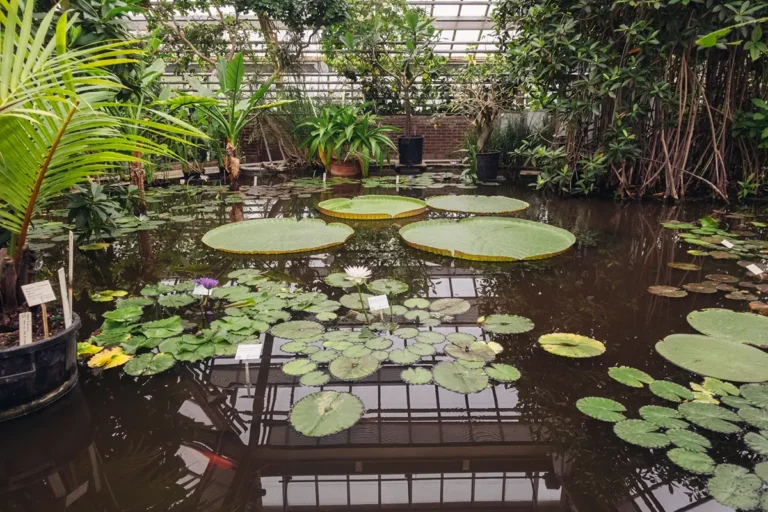
This impressive glass building, built between 1880 and 1882, was the largest greenhouse in the world at the time – with a surface of 2500 square meters and constructed of 45,000 glass panels! Moreover, the Palmenhaus has an extensive collection of tropical plants spread over three climate zones.
3. Wüstenhaus (Desert House)
Originally the Wüstenhaus or Desert House was built as the Sonnenuhrhaus in 1904. But as recently as 2003 the building was turned into a desert habitat where you can check plants from the desert landscapes of Central America to Madagascar. The focus is on cacti and other succulents.
4. Orangeriegarten (Orangery Garden)
This orangery, built around 1754, is one of the largest in Europe and was used to protect exotic and tender plants, especially citrus trees. Nowadays the building consists of two sections: a concert hall and a space to help tender plants through the Austrian winters.
5. Irrgarten (maze)

‘Sich irren’ in German means ‘to mistake’. So you can imagine what an ‘Irrgarten’ is: a garden where you will probably make some mistakes to get to the center – and to get out again. Originally the maze was created in the 18th century and was later reconstructed. It offers a fun challenge for visitors – both for children and adults.
6. Japanese garden
The Japanese garden, on the south side of the Palmenhaus, was created on 1913 and rediscovered in 1996. It consists of a dry landscape garden and a tea garden that symbolizes the friendship between Japan and Austria.
7. Kronprinzengarten (Privy Garden) and Garten am Keller

These private gardens once belonged to the imperial family. You can find them on the east side of the Schönbrunn palace. The Garten am Keller design is Baroque, with an intricately designed ‘parterre de broderie’ and an octagonal bassin.
8. Neptunbrunnen (Neptune Fountain)

There are multiple beautiful fountains in the palace grounds, but arguably the most beautiful one is the Neptunbrunnen (Neptune Fountain). It was built in 1770 and reflects the imperial ambitions of the Habsburgers. The fountain consists of a big basin of water with an enormous stone fountain adorned with figures from Roman mythology. Central is Neptune, the Roman god of the seas, with his trident in his hand. Thetis, a sea goddess, kneels before Neptune. Sea horses and Tritons (yet more sea gods) dominate the rest of the fountain.
The fountain is in operation between April and October (depending on the weather conditions and maintenance), usually between 11 am and 3 pm.
Schloss Schönbrunn palace map
To quickly find your way around the vast palace grounds, here’s a useful map of the Schloss Schönbrunn palace grounds.

Schloss Schönbrunn tickets
Most of the palace grounds of Schloss Schönbrunn are free to visit. There are however parts of Schönbrunn Palace and the gardens for which you need a ticket. You could of course buy separate tickets for each attraction, but there are also some combined tickets available. Depending on what you would like to see and how much time you have, it really pays off to do some planning.
Guide to Schönbrunn palace tickets
You can purchase your tickets on the Schönbrunn website or the Vienna Zoo website. There are different tickets available, depending on which parts you want to visit.
With the Classic Pass Plus you can visit everything: the Schönbrunn Palace, Tiergarten, Gloriette, Maze, Privy and Orangery gardens and the greenhouses.
Ain’t got no time (or money) for all that? There are also passes available for the individual parts to see only the sights you don’t want to miss.
How to get to Schönbrunn Palace?
Public transportation in Vienna is excellent. It is also the easiest way to get around. There are many ticket options for public transport where you don’t have to buy single tickets. It’s also quite cheap and gets cheaper for longer stays. As of October 2025, a ticket for 24 hours is 8 euros, 48 hours costs € 14,10, 72 hours is € 17,10. And a ticket for a week is … € 19,70. With these tickets you can use the bus, tram and underground, and it will take you to pretty much every corner of Vienna – including Schloss Schönbrunn.
To get to Schönbrunn, take the underground U4 to the stop ‘Schönbrunn’, or trams 10 and 60, or bus 10 A, which both stop at ‘Schloss Schönbrunn’. Easy peasy!
Plan your trip and buy your tickets at Wiener Linien.
Garden love – delivered to your inbox.
Sign up for weekly gardening tips, inspiration and more.