✉ hello@onemoregarden.com


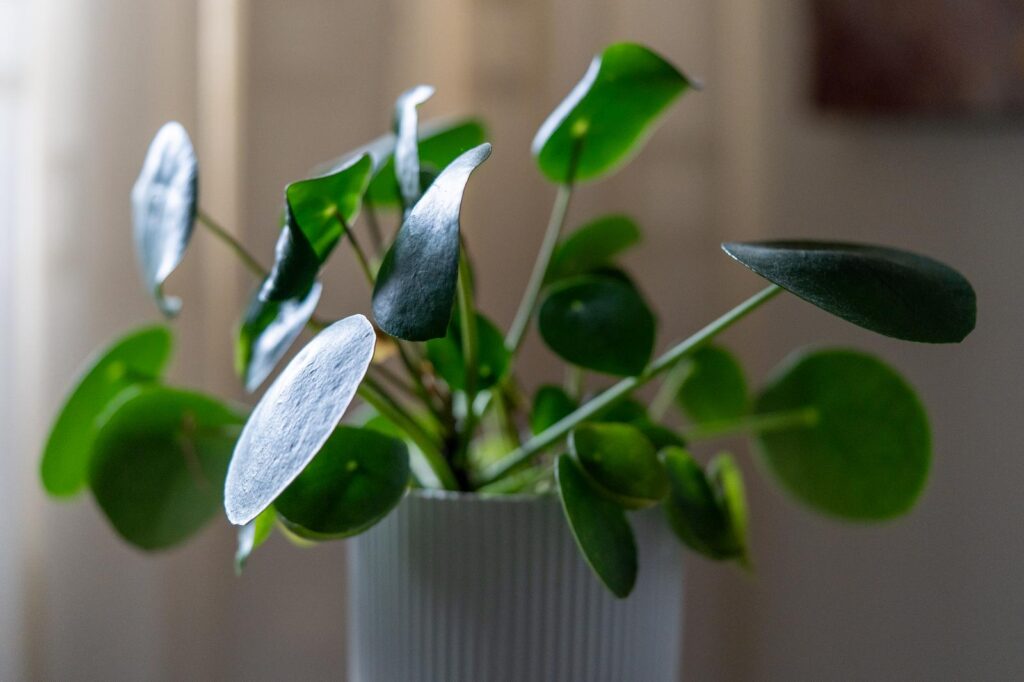
You don’t need a particularly green thumb to keep a Chinese money plant alive. The Pilea peperomioides – also called the pancake plant because of its round leaves – is a wonderful roommate for people who like house plants, but the plant care part … not so much. Still, ‘low maintenance’ doesn’t mean ‘no maintenance’. Like every living thing, your Pilea has preferences. Here’s how to keep it thriving.
Chinese money plant care: the 7 essentials
Looking for a simple houseplant that looks great and grows fast? The Chinese money plant (Pilea peperomioides) is perfect for beginners. Stylish, low-maintenance, and endlessly photogenic – this plant checks every box. But even this minimalist beauty has its quirks. Learn how to keep your Pilea healthy, balanced, and ready for its next close-up.
1. No harsh light for your Pilea

Pileas love light, but not the harsh kind. Think bright, indirect daylight – near a window, not in it. A north facing window is ideal, but a few hours of gentle, indirect morning sun is also great. However, the blazing afternoon kind is not! If your plant starts leaning dramatically toward the window, that’s a polite hint it wants more even light.
2. Water wisely
If overwatering were a crime, most beginner plant parents would be serving time. The Chinese money plant likes consistency, not constant moisture. Touch the top inch of soil – if it’s dry, water it. If it’s still damp, wait. In summer, that might mean twice a week, in winter, maybe once.
3. Feed, don’t fatten
Your Pilea doesn’t need fancy supplements or a complicated feeding schedule. A diluted, liquid houseplant fertilizer once a month during spring and summer is plenty. Skip feeding the Chinese money plant in winter. In the dark season growth slows down and your plant won’t use all that food.
4. Mo’ money! Chinese money plant propagation

One of the Pilea’s most charming habits? It produces babies – lots of them. Tiny shoots often pop up at the base of the mother plant. Once they’re a few centimeters tall, you can gently separate them and replant them in fresh soil. It’s plant care meets social connection: the Chinese money plant is meant to be shared. So gift a cutting, and you’ve passed on something living. Your friends and family will love you even more.
5. Keep your Chinese money plant symmetrical
Because Pilea peperomioides grows toward the light, it can end up leaning like an overenthusiastic yoga student. The solution is simple: give the pot a quarter turn every week. Let’s call it ‘plant pilates’. I’ll see myself out.
Bonus: You’ll notice your plant more, which makes you a better caretaker by accident.
6. Pay attention to the leaves

Your Pilea is surprisingly expressive. Yellowing leaves usually mean too much water. Crisp brown edges suggest too little. Curling leaves? Possibly too much sun or too little humidity – or even lice. Spot a problem? Don’t panic! Plants, like people, have off days. Trim old leaves, adjust the light or water slightly, get rid of any bugs and it’ll bounce back in no time.
7. Embrace the effortless style
Part of the Pilea’s charm is how sculptural it looks – like a little green satellite dish farm. And because of its modest size, it fits anywhere: a minimalist apartment, a cluttered studio, even a kitchen shelf. It doesn’t shout for attention, but it always draws the eye.
In short:
- Keep it bright, not blazing.
- Keep it moist, not muddy.
- Feed it lightly, not lavishly
- Rotate occasionally, share generously.
That’s it. The Pilea peperomioides really is one of the best house plants for beginners – and for indoor jungle enthusiasts alike.