✉ hello@onemoregarden.com



Not all deserts are created equal, and this also applies to the deserts of the US. Each of the North American deserts has its own unique ecosystem – and its own iconic plants.
Types of desert environments
When you look at the differences in temperature, geographic location, and the amount and seasonality of rainfall, you can divide the deserts of the world in five types:
- Hot and dry deserts: The temperatures are high and they have very little rainfall.
- Semi-arid deserts: Here temperatures are more moderate and they have a little rainfall.
- Coastal deserts: Here the temperatures are actually mild. They still don’t have a lot of rain, but they do have more fog.
- Cold deserts: The cold arid lands have low temperatures and low amounts of rain.
- Polar deserts: These white landscapes in the Arctic are very cold and precipitation is very low.
Major deserts in the US
The United States is home to four major deserts: three of these are hot and dry, while the fourth one is cold. Each of them has its own distinct characteristics and plant life. Learn more about each desert and its iconic plants:
- The Mojave Desert: This is the smallest but driest desert in the US, home to the famous Joshua tree.
- The Sonoran Desert: The Sonoran Desert is known for its unique rainfall pattern and of course the tall Saguaro cactus.
- The Chihuahuan Desert: Features characteristic mountain ranges and broad valleys, with most rainfall occurring during summer monsoon.
- The Great Basin Desert: The largest and only cold desert among the four, where plants adapt to both freezing winters and hot summers.
Each of these dry landscapes is a unique ecosystem with its own specialized plant life that has evolved to survive (even thrive) in these incredibly harsh environments. From the towering Saguaro cacti of the Sonoran to the hardy Big Sagebrush of the Great Basin, these plants tell the story of adaptation and survival in America’s arid lands.
The most iconic plants of the Mojave Desert
The Mojave is famous for its unique landscapes, including Death Valley (the hottest, driest place in North America) and the iconic Joshua Tree. The remarkable plants of the Mojave Desert are uniquely adapted to its harsh conditions.
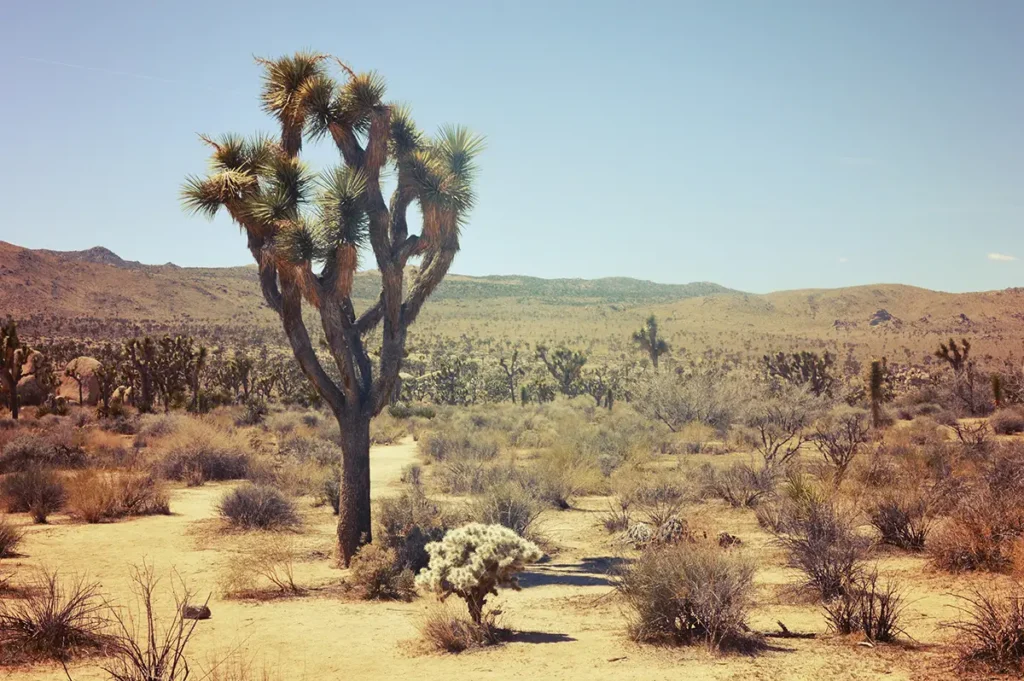
- Mojave Desert states: Spans across California, Nevada, Utah, and Arizona
- Climate: Extremely arid, home to Death Valley (the hottest, driest place in North America)
Here are some of the most iconic plants of the Mojave Desert:
1. Joshua tree (Yucca brevifolia)
A lot of people know the Joshua tree by name thanks to Irish band U2, who actually named an album after this iconic tree. This symbol of the Mojave Desert can reach up to 40 feet (12 m) tall and has a bunch of branches that stick out in strange directions.The branches are green so the tree can photosynthesize even when the leaves can’t.
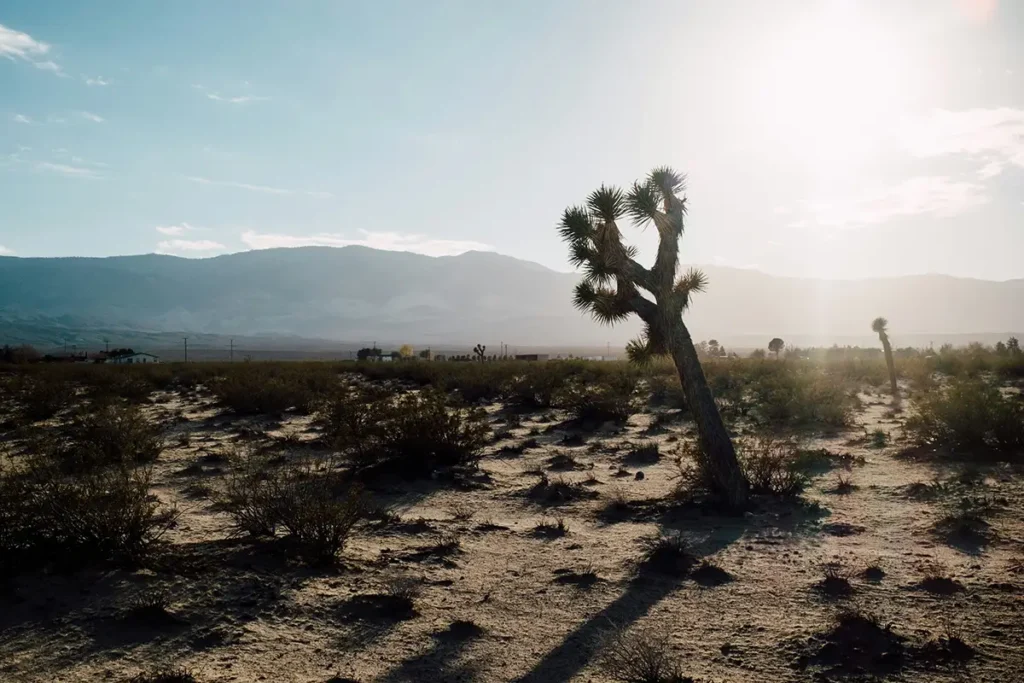
When the old leaves die, they don’t fall off but stay stuck to the trunk, making the tree look like it’s wearing a shaggy coat. In late winter or early spring, it grows bunches of small white-greenish flowers, and later makes spongy, egg-shaped fruits. The whole tree looks so unique that you’d never mistake it for anything else!
TL,DR: Joshua tree:
- Grows up to 40 feet (12 m) tall
- Retains dead leaves as a protective coat
- Produces white-greenish flowers and egg-shaped fruits
2. Creosote bush (Larrea tridentata)
The creosote bush is like a really smart survivor! It grows to about 12 feet tall and has a grayish trunk with lots of little knots on it. When it rains in the desert, these bushes release a distinctive resinous scent (the smell of rain). In spring (and sometimes summer and fall if there’s enough water), it grows bright yellow flowers that turn into fuzzy, white, ball-shaped fruits. A single creosote bush can reach an age of a hundred years.

TL,DR: Creosote bush:
- Reaches heights of about 12 feet
- Releases the desert’s characteristic ‘rain smell’
- Produces bright yellow flowers and fuzzy white fruits
3. Mojave aster (Xylorhiza tortifolia)
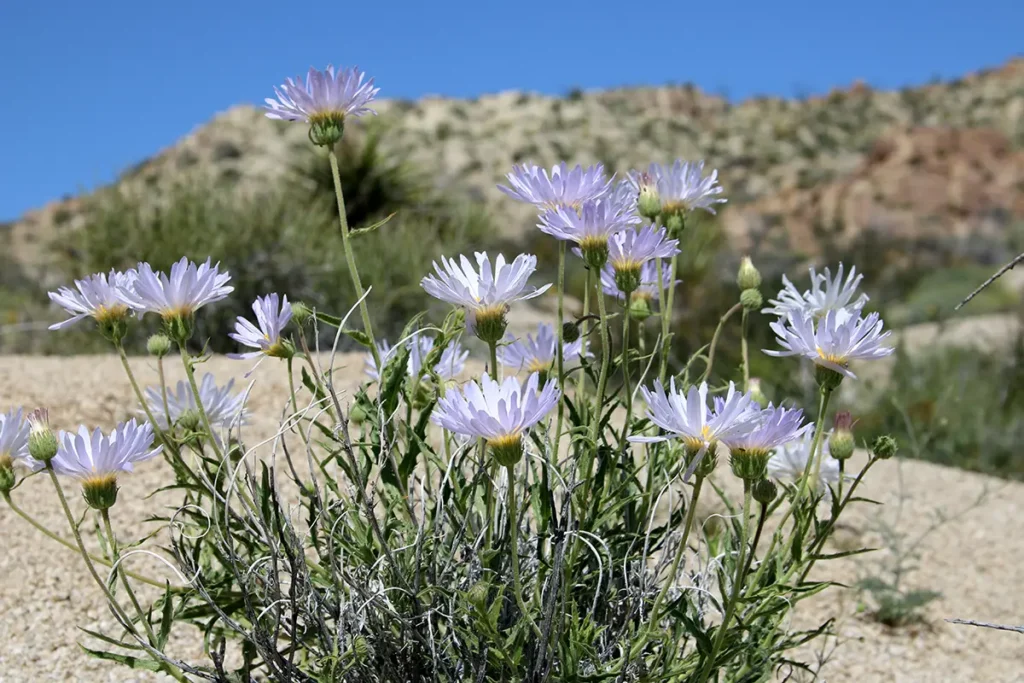
The Mojave aster adds a splash of color to the desert with its delicate lavender petals and yellow centers. This perennial wildflower grows on rocky hillsides and in sandy soils. Once established, it thrives on summer droughts. While summer water may cause the leaves to drop, late summer rains can encourage a second bloom in fall.
TL,DR: Mojave aster:
- Lavender flower petals with yellow centers
- Thrives in rocky and sandy soils
- Can bloom twice in a year with proper rainfall conditions
The most iconic plants of the Sonoran Desert
The Sonoran Desert is hot and dry, but actually is one of the most lush deserts in the world. That is thanks to its so-called ‘bimodal’ rainfall pattern. What this means is that it has a wet season with two rainfall peaks, with at least one dry month between them. Some plants of the Sonoran Desert are so characteristic you recognize them instantly.
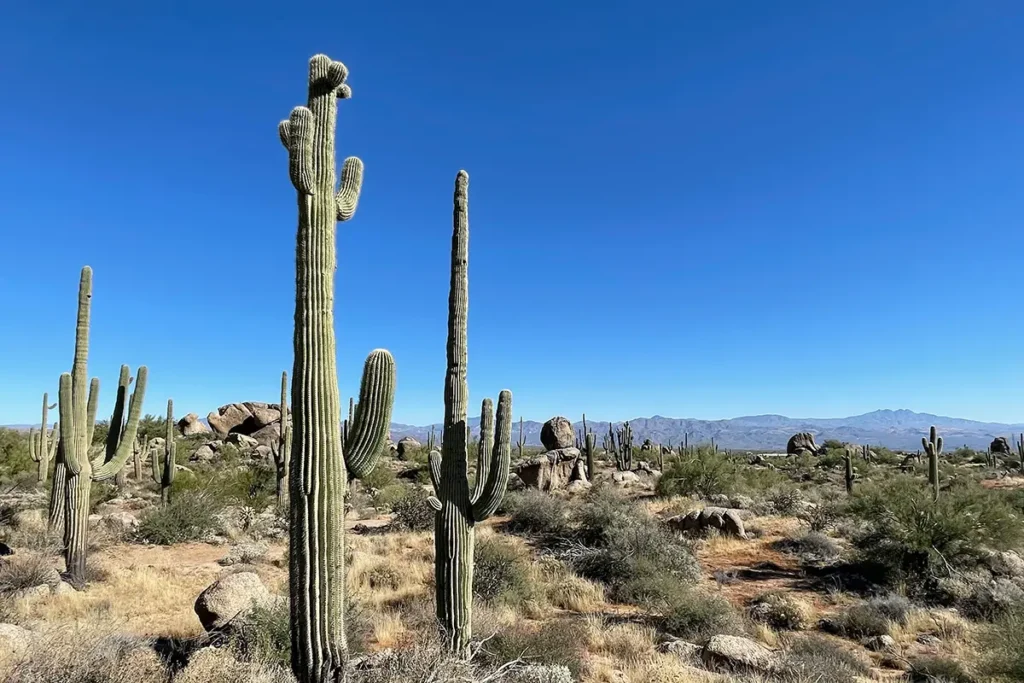
- Sonoran Desert states: Arizona, California
- Climate: Very hot desert, with summer temperatures that can exceed 120°F (49°C). But unlike other deserts, it has two rainy seasons (one in winter and another in late summer).
Here are some of the most iconic plants of the Sonoran Desert :
1. Saguaro cactus (Carnegiea gigantea)
It’s one of the most iconic plants of the Sonoran Desert: the famous saguaro cactus. In fact, this is the only place in the world where this cactus grows in the wild. The saguaro is pollinated by the “3 B’s”: bees, birds and bats. Birds also love the red fruits and thereby spread the seeds far and wide.
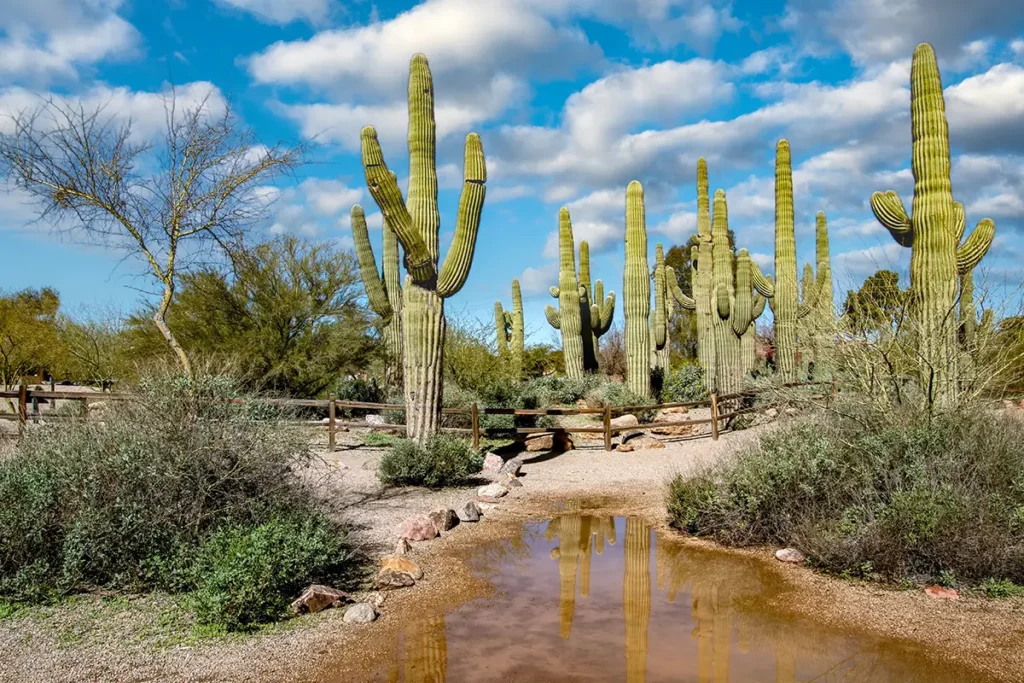
The saguaro is one of the tallest cacti in the world, but it is also a slow grower. They only start flowering when they’re at least 40 years old, and get their arms between the ages of 50 and 100 years.
TL,DR: Saguaro cactus:
- Found naturally only in the Sonoran Desert
- Begins flowering at 40+ years of age and develops arms between 50-100 years old
- Pollinated by the “3 B’s”: bees, birds, and bats
2. Yellow palo verde (Parkinsonia microphylla)
The yellow pale verde is one of the most common trees of the Sonoran Desert. They grow about as tall as an adult giraffe (16 feet, or 5 meters). What makes this tree stand out is its green bark. That means it can not only photosynthesize through its leaves, but also its bark. Which is great, because when it gets too hot and dry, the tree drops its leaves and still has a backup food source. When the rains come again, the palo verde bursts into celebratory flower.

TL,DR: Yellow pale verde:
- Grows to approximately 16 feet (5 meters)
- Has green bark for photosynthesis
- Produces spectacular seasonal flower displays
Tip: Sonoran Desert botanical garden

If you only have one day to explore the big Sonoran Desert, a visit to the Arizona-Sonora Desert Museum in Tuscon, Arizona is the perfect destination. This place is 98 acres of botanical garden, zoo and museum in one, so you can explore the entire Sonoran Desert – both plants and animals – in a short time.
3. Organ pipe cactus (Stenocereus thurberi)
This vertical growing desert cactus grows white or purple flowers that are pollinated by insects and bats. After that, they grow amazing fruits called ‘pitahaya dulce’. These can grow as big as oranges and taste like watermelon. Native peoples ate the fruits fresh or turned them into all sorts of products – jams and syrups, but also flour from the seeds. Other parts of the cactus made good fences, for example, or were used to treat snake bites.
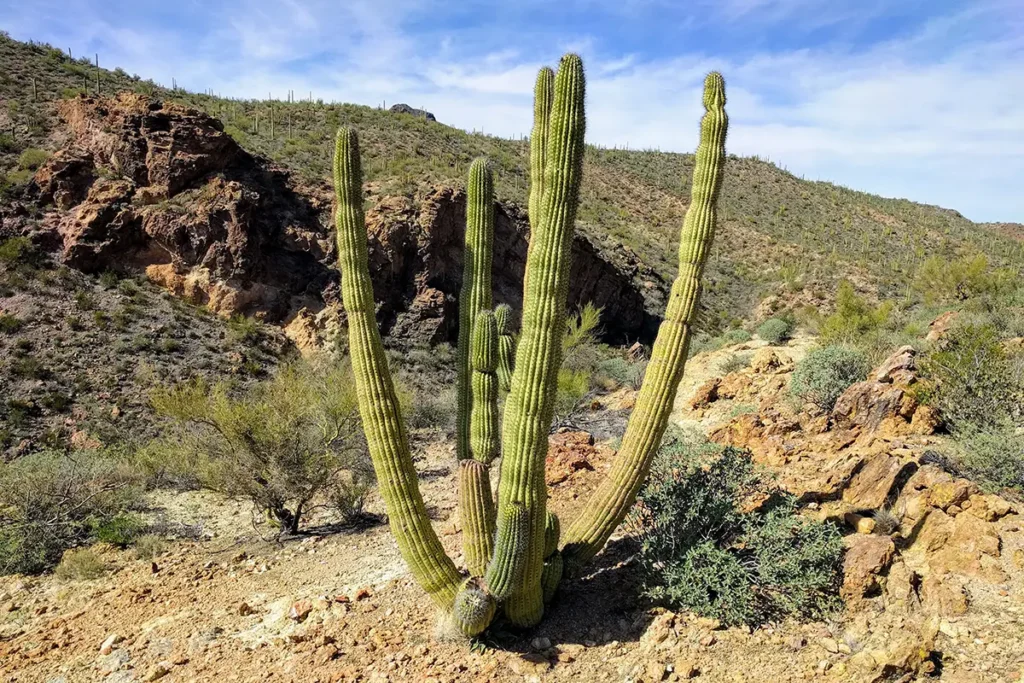
TL,DR: Organ pipe cactus:
- Produces white or purple flowers attracting bats and insects
- Bears watermelon-flavored fruits called ‘pitahaya dulce’
- Historically used for food, medicine, and construction
The most iconic plants of the Chihuahuan Desert
The Chihuahuan Desert has characteristic mountain ranges and broad valleys. This desert, of which only a small part is in the US, gets most of its rain in the summer, mainly during monsoon thunderstorms. That means it gets a lot of rain all at once – and then stays dry again for a long time.. Plants of the Chihuahuan Desert must therefore make the most of this short window of opportunity for survival.
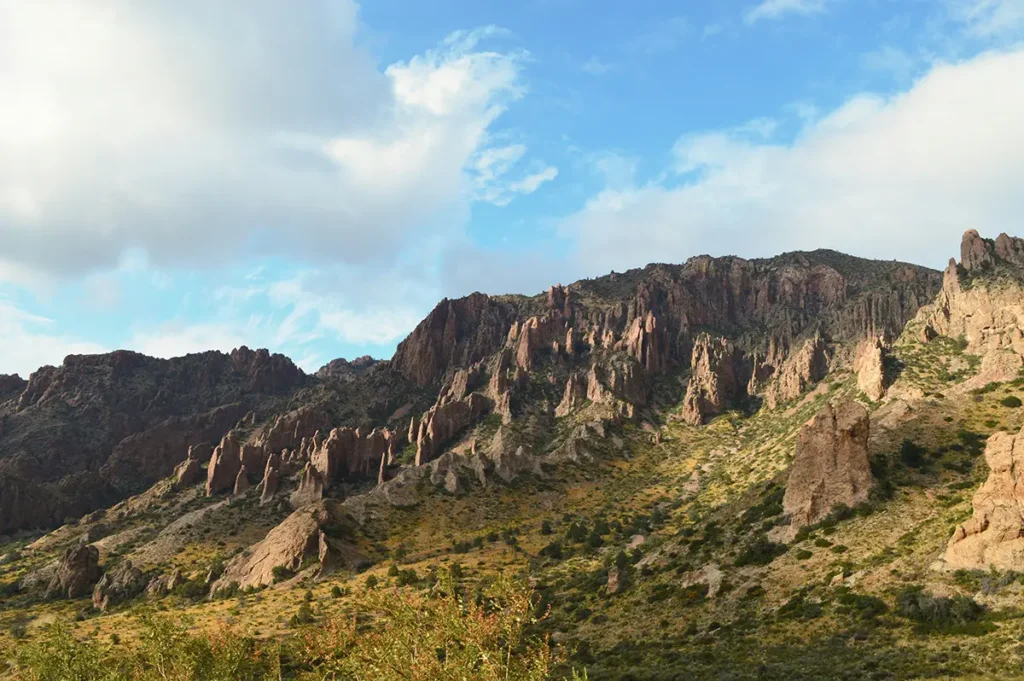
- Chihuahuan Desert states: Texas, New Mexico (90% of this desert is in Mexico)
- Climate: The Chihuahuan Desert is a high-elevation, semi-arid desert with milder temperatures than the Sonoran and Mojave Deserts, though summers are still hot. Most rain falls in the summer.
Here are some of the most iconic plants of the Chihuahuan Desert :
1. Lechuguilla (Agave lechuguilla)
This small agave species is native to the Chihuahuan Desert and it’s also the only place where it grows. This agave has spiky, sharp-tipped leaves and it flowers only once in its lifetime. It can reach an age of anywhere between 3 and 21 years, but if during that time it gets sufficient rainfall, it can burst into flower – and after flowering it dies.
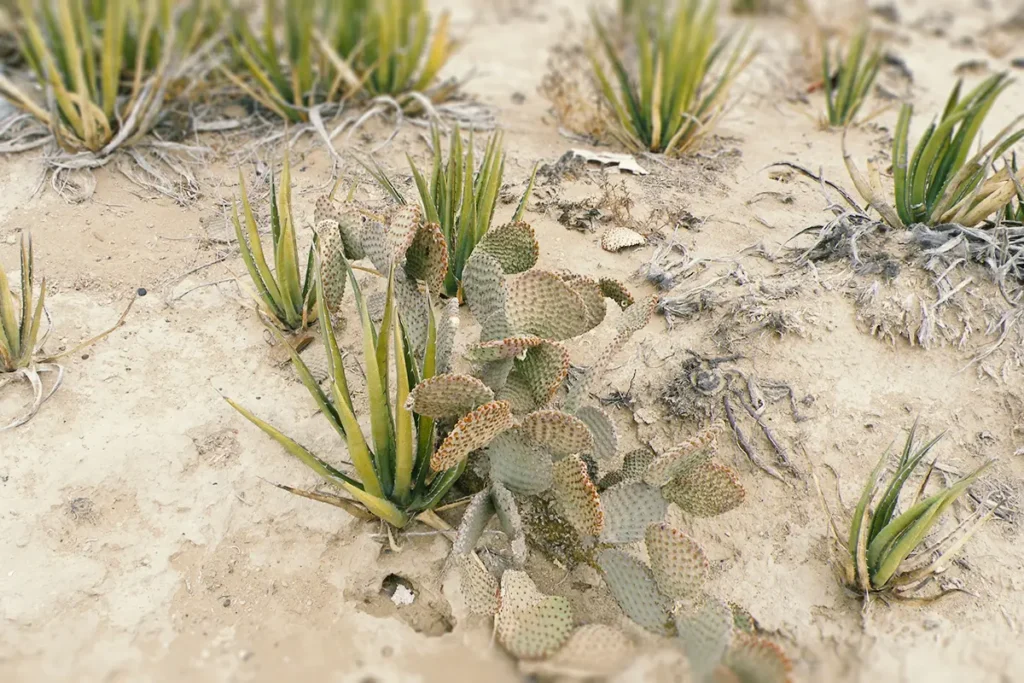
TL,DR: Lechuguilla:
- An endemic species found nowhere else in the world
- Flowers once in its lifetime, but blooming depends on sufficient rainfall
- Lives between 3-21 years
2. Soaptree yucca (Yucca elata)
This tall tree-like yucca can grow as tall as a house (up to 20 feet). Its spiky blue-green leaves grow in a pattern that looks like a giant star. In summer, the soaptree yucca grows beautiful white, bell-shaped flowers on a tall stalk.

Native Americans found lots of uses for this plant: they made shampoo from its roots (hence the name), ate the flowers, and used the leaf fibers to make ropes and baskets. The plant is super tough, It rarely needs water once it starts growing, and can survive freezing temperatures.
TL,DR: Soaptree yucca:
- Grows up to 20 feet tall, with distinctive blue-green leaves in a star pattern
- Produces white, bell-shaped summer flowers
- Historically used for soap, food, and fiber
3. Ocotillo (Fouquieria splendens)
With its long, spiny, wand-like stems, the ocotillo is an iconic plant of the Chihuahuan Desert. It grows and loses its small leaves up to five times a year, depending on when it rains. When the leaves fall off, they leave behind tiny spines, and the plant has a special waxy coating that helps it save water in the hot desert. During rainy periods, it produces bright red flowers, which attract hummingbirds and add vibrant color to the desert
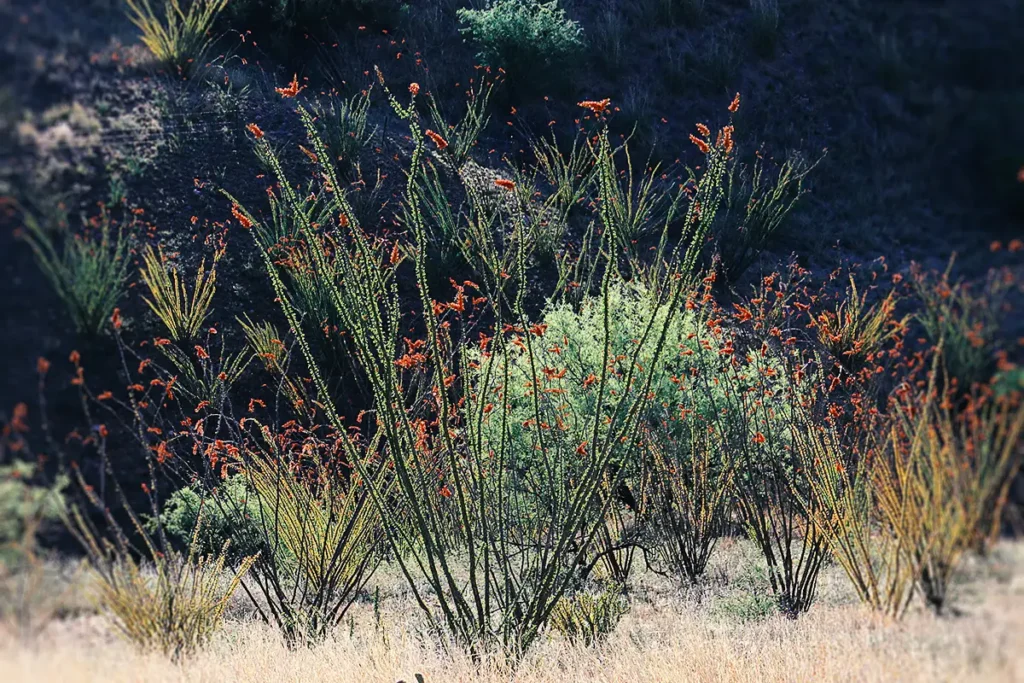
TL,DR: Ocotillo:
- Has spiny, wand-like stems
- Cycles through leaf growth up to five times annually
- Produces bright red flowers attracting hummingbirds
The most iconic plants of the Great Basin Desert
The Great Basin Desert covers an area of around 190,000 square miles (almost 500,000 square km). That makes it the largest of the four major deserts in the US. But unlike the hot and dry Mojave, Chihuahua and Sonoran Deserts, the plants of the Great Basin Desert have to deal with freezing winter temperatures, heat in the summer and low moisture.
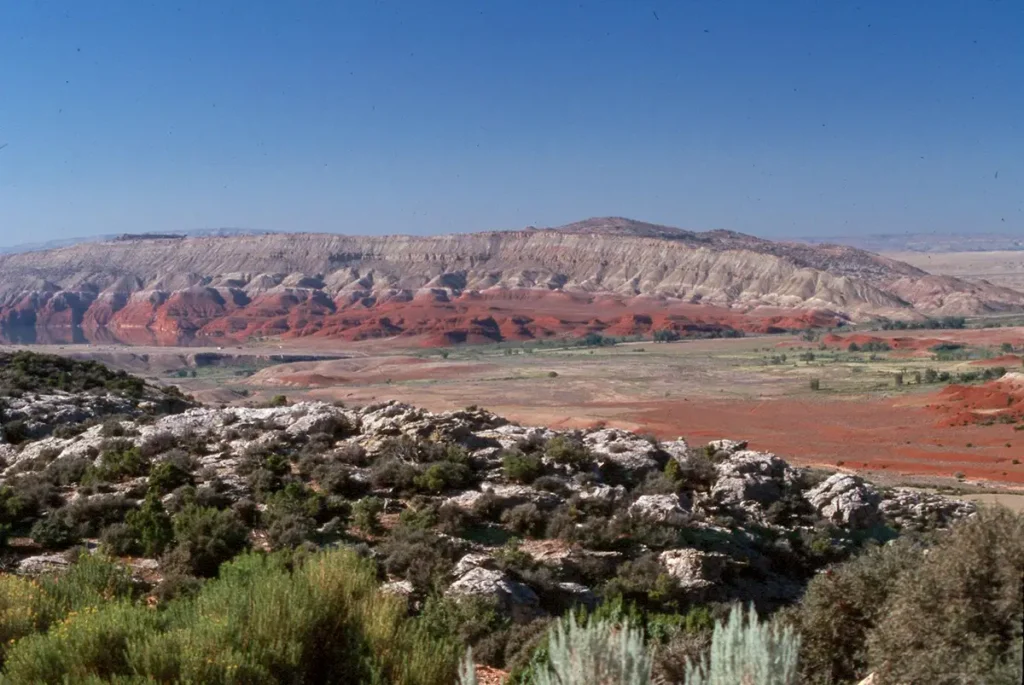
- Great Basin Desert states: Nevada, Utah, California, and Idaho
- Climate: The Great Basin Desert is a cold desert, which experiences cold, snowy winters and hot, dry summers.
Here are some of the most iconic plants of the Great Basin Desert:
1. Big sagebrush (Artemisia tridentata)
The Great Basin’s signature plant is the big sagebrush, which is known for its silvery-gray leaves and spicy, bitter smell. It may not seem appealing at first, but its unique look often grows on people. It has silvery, fragrant leaves and is highly adapted to cold desert conditions.
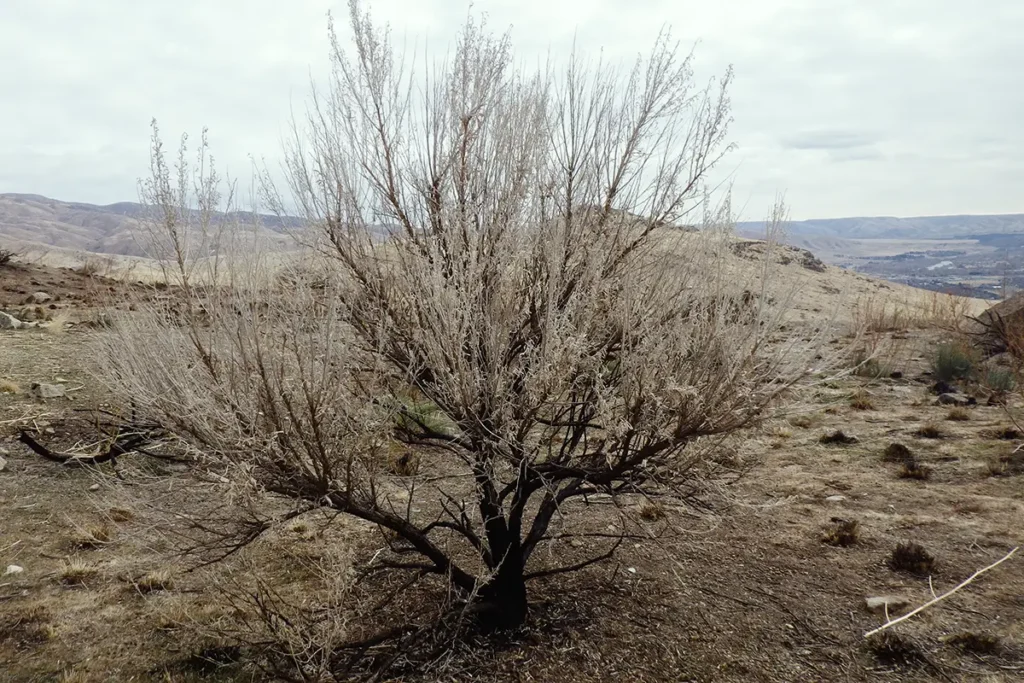
This sagebrush has small, three-toothed leaves and pale yellow flowers that bloom in late summer. It thrives in cold, dry deserts, where it’s joined by junipers and desert grasses. Sagebrush was important to Native Americans for medicine, tea, fuel, and making ropes. Today, it’s Nevada’s state plant.
TL,DR: Big sagebrush
- Has silvery-gray, fragrant leaves
- Produces pale yellow late-summer flowers
- Historically used for medicine, tea, and rope-making
2. Shadscale (Atriplex confertifolia)
This tough little desert bush grows one to three feet (30 – 90 cm) tall and has grayish-green leaves. It can handle salty soil and freezing cold weather. From March to June, it grows fruits that taste salty, and produces seeds that are valuable for wildlife during colder months. It sheds some leaves to conserve water during drought. Native Americans traditionally ground its fruits into flour. Even today, it remains important for forage, especially in winter.

TL,DR: Shadscale
- Hardy desert shrub that grows 1-3 feet (30-90 cm) tall
- Tolerates both saline soils and freezing temperatures
- Produces valuable wildlife food
3. Piñon pine (Pinus monophylla)
The singleleaf piñon pine is a small, hardy tree that grows in the dry, mountainous areas of the Great Basin Desert in the western U.S,. The Pinus monophylla survives in tough, dry conditions where few other trees can thrive.

Thousands of years ago, when the climate was colder, this tree mostly lived in the southern parts of the desert. But as the world warmed up, it started spreading northward, finding new places to grow. Animals like Pinyon Jays and squirrels helped by carrying its seeds to new areas. Today, this pine is important because it provides food, like tasty pine nuts. Also, its roots help prevent erosion, stabilizing the desert’s rocky soil.
TL,DR: Piñon pine
- Thrives in dry, mountainous areas
- Provides valuable pine nuts
- Crucial to the desert ecosystem, helps prevent soil erosion