✉ hello@onemoregarden.com



Ever wondered where the idea for those dazzling symmetrical gardens surrounding palaces and chateaux came from? It wasn’t a sudden burst of French eccentricity. The concept of the jardin à la française is a cocktail of different cultures – rooted in Persian design principles, spiced up by the Italian Renaissance, and perfected by the very best French landscape designers. From optical illusions to grand avenues, the French garden mixes beauty and power. This is how the French garden conquered Europe.
Definition of the French Garden
When we talk about the ‘French garden’, what we actually mean is the formal French garden style, also known as jardin à la française. This garden style reached its peak during the 17th century and is characterized by clean lines, impressive avenues and symmetrical patterns.
But the great French landscape designers of the age didn’t invent this out of thin air. They found their inspiration in the ancient Persian ‘paradise garden’. The Italians borrowed the idea and gave them Renaissance flair. Then the French – never ones to be outdone in matters of drama – magnified the whole thing to a scale that eventually culminated in the famous gardens of Versailles.
The importance of symmetry in French gardens
If you suffer from a need to rigidly control your environment, the formal French garden is your spiritual home. Perfect symmetry is one of its defining features. Symmetry inspired many architects and landscape designers in the past, but the French have become particularly known for it.
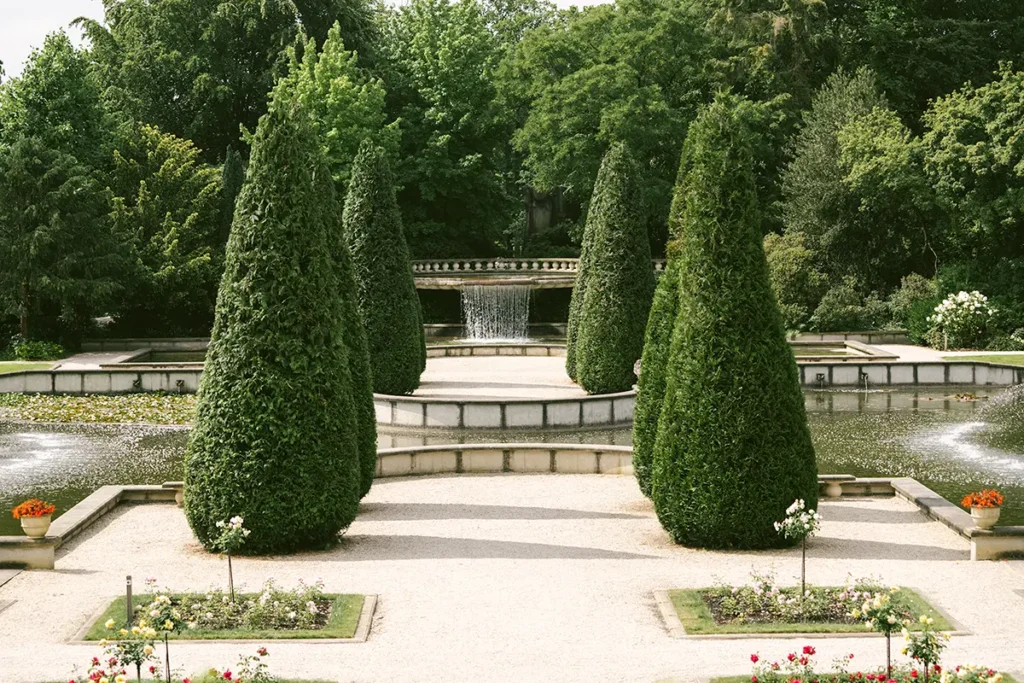
They used symmetry to great effect in their gardens to create a sense of calm and control. Nothing in the design was left to chance – from ponds to flower beds, and from stairs to lanes of trees. It all contributed to a harmonious whole. Symmetry in these gardens was more than just aesthetic. It reflected the 17th-century obsession with rationality, elegance, and the belief that man’s intellect should triumph over the chaotic wilderness.
Optical illusions in French garden design
But do not let the rigid lines fool you. The French formal garden is a theatrical stage, designed to trick the eye and play with your mind.
If there is one designer that has become pretty much synonymous with the French garden, it is André le Nôtre (I mean, he did design the famous gardens of Versailles). This man had a great talent for playing with perspective and manipulating scale.
From the terrace of a chateau or palace the garden seems perfectly symmetrical. But once you start walking, you will discover hidden stairs, fountains and surprising asymmetrical patterns. This clever garden design makes it seem as if the garden lures you in deeper and deeper. Exactly this is what makes the so-called French garden so unique.
Main difference between English garden and French garden
When comparing French and English gardens, the contrasts are evident. French gardens require meticulous planning, with a focus on symmetry, order and grandeur. In contrast, English gardens aim to mimic nature with their wilder, more organic layouts. They try to create a feeling of ‘untamedness’. Both styles have their own charm, but the French garden soon became a symbol of royal power and prestige. That is why in the 17th and 18th century, many courts throughout Europe promptly copied the French style.
| Feature | The French Garden | The English Garden |
|---|---|---|
| Philosophy | Total control over nature. | An idealized, romantic imitation of nature. |
| Layout | Rigidly geometric, symmetrical, and linear. | Curved lines, organic shapes, and rolling hills. |
| Atmosphere | Architectural grandiosity and royal prestige. | Calculated ‘untamedness’ and pastoral romance. |
| Maintenance | Relentless clipping, weeding, and sweeping. | Curated chaos (though still requiring hard work!). |
Key elements of French garden design
French gardens are known for their specific features, which create a distinct sense of order and grandeur. These key elements include:
- Symmetrical layouts. The layout is highly structured, with pathways, parterres (formal embroidery garden beds) and lawns arranged in strict geometric patterns.
- Wide avenues. The formal French gardens have a dominant central axis, often leading straight to the main building, or to a central point like a fountain or statue. This wide avenue serves as the spine of the garden, forcing your eyes toward the horizon.
- Grand terraces. These gardens are often designed on terraces, providing a vantage point to admire the entire landscape.
- Water features. Reflecting pools, canals and fountains don’t just add sound and movement, they act as giant mirrors to duplicate the architecture and double the sense of space.
- Topiary. Trees and shrubs (often boxwood or yew) are meticulously pruned into geometric shapes to maintain the controlled aesthetic.
- Statues and ornaments. Classical sculptures, stone urns and vases are important features of the formal French garden and they reinforce the theme of refinement and order.
Persian origins of the French garden
The French garden design as we know it actually started far away from France, in Persia (modern-day Iran). The gardens from the land of Arabian Nights were designed according to the concept of the ‘paradise garden’: a vision of paradise on earth. This ancient design philosophy, with four ‘rivers’ flowing from a central point and dividing the world in four quadrants, laid the groundwork for the geometric order that the Europeans later adopted.
Influence of the Italian Renaissance on the French garden
Fast forward to Italy during the Italian Renaissance (roughly between the 14th and 16th century), when art and nature became the main influences. During this era, the first gardens with clean geometrical patterns started to emerge, usually around the famous villas of the Italian elite. Think lavish fountains, mysterious grottos and impressive stairs leading to spectacular views.
This Italian splendor drew the attention (and maybe a bit of jealousy) of the French landscape designers, who couldn’t wait to add a bit of that magical Italian touch to their own jardins. The French borrowed their favorite elements and added their own innovations – such as longer avenues and grand parterres.
André le Nôtre: master of symmetry and illusion
No discussion of French gardens is complete without mentioning André le Nôtre (1613 – 1700), the landscape architect behind the most famous French gardens, including Versailles. Le Nôtre revolutionized garden design by using a combination of symmetry, perspective, and mathematics to create sprawling landscapes that seemed to stretch endlessly.

His most famous masterpieces are the gardens of Versailles and Vaux-le-Vicomte, but he also helped design many other impressive gardens both in France and abroad, such as the gardens of Bicton Park Botanical Gardens in Devon (England), Jardin des Tuileries in Paris and Château de Sceaux. His designs emphasized grandeur and control, embodying the absolute power of the monarchy. Today, his legacy lives on in some of the most visited gardens worldwide.
TL,DR: Quick questions, straight answers about French gardens
What actually defines a French garden? A formal French garden (jardin à la française) is defined by strict symmetry, grand axial views, elevated terraces, clipped topiary, and geometric water features designed to show man’s control over nature.
Where did the French garden style originate? It’s a mix. The basic geometric layout comes from ancient Persian paradise gardens, which were later adapted into the theatrical, terraced villa gardens of the Italian Renaissance before being blown up to a grand scale by the French.
How do French gardens differ from English ones? French gardens are formal, rigid, and value symmetry and order above all else. English gardens are romantic and organic, deliberately designed to mimic a wilder, more pastoral version of nature.
Who is the most famous French garden designer? André le Nôtre. He was the master landscape architect behind the sprawling gardens of Versailles and Vaux-le-Vicomte during the reign of Louis XIV.
What are the best examples to visit? The gardens of Versailles, the Jardin des Tuileries in Paris, and the stunning grounds of Château de Sceaux are the quintessential blueprints of the style.